

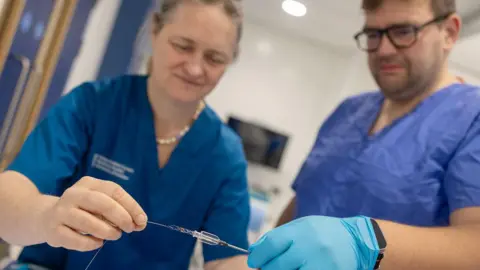
Surgeons from the Scottish region and the United States have performed what is considered a pioneering stroke procedure employing automated systems.
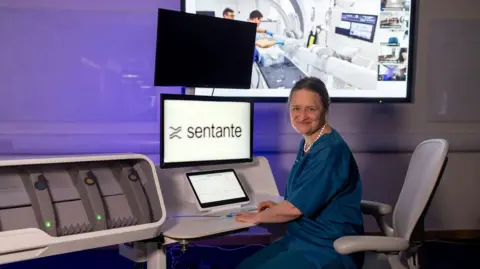
Prof Iris Grunwald, associated with a research center, performed the distant clot removal - the removal of blood clots after a cerebral event - on a human cadaver that had been provided for research.
The professor was positioned in a treatment center in Dundee, while the specimen being treated while using the machine was at another location at the university.
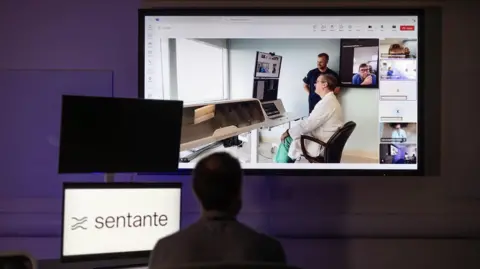
Subsequently, a neurosurgeon from Florida used the system to conduct the first transatlantic surgery from his American facility on a human body in Dundee over 4,000 miles away.
The research collective has labeled it a potential "game changer" if it receives authorization for clinical application.
The surgeons believe this innovation could revolutionize stroke treatment, as a slow access to expert care can have a major influence on the recovery prospects.
"It felt as if we were observing the early preview of the coming era," said the lead researcher.
"While in the past this was thought to be futuristic fantasy, we showed that each phase of the operation can now be performed."
The Scottish institution is the worldwide teaching facility of the international stroke organization, and is the only place in the United Kingdom where surgeons can operate on cadavers with human blood pumped through the arteries to mimic treatment on a live human.
"This was the first time that we could perform the entire surgical process in a genuine medical subject to demonstrate that every phase of the surgery are achievable," explained the primary researcher.
A healthcare leader, the chief executive of a health foundation, called the intercontinental surgery as "a remarkable innovation".
"During many years, individuals from isolated regions have been denied availability to clot removal," she continued.
"Robotics like this could rebalance the inequity which exists in stroke treatment throughout Britain."
What is the operational process?
An blockage stroke takes place when an artery is blocked by a obstruction.
This interrupts circulation and oxygenation to the neural matter, and neural cells cease working and expire.
The best treatment is a surgical extraction, where a specialist uses medical instruments to extract the blockage.
But what occurs when a patient is unable to reach a expert who can conduct the operation?
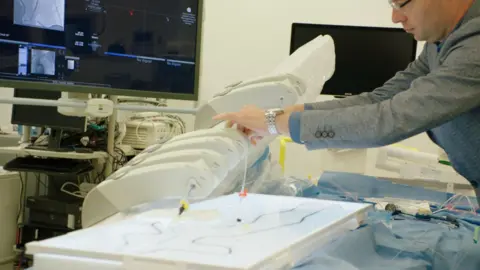
The medical expert said the study proved a automated system could be attached to the equivalent surgical tools a surgeon would conventionally utilize, and a medical staff who is present with the individual could simply attach the tools.
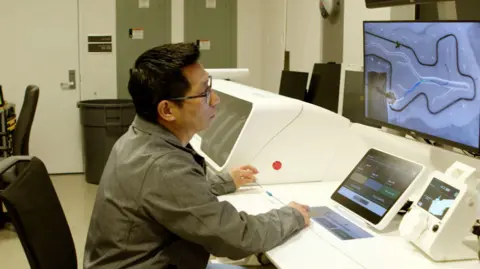
The surgeon, in another location, could then hold and move their own wires, and the mechanical device then executes exactly the same movements in live timing on the patient to conduct the clot removal.
The patient would be in a hospital operating room, while the surgeon could perform the surgery with the technological system from anywhere - even their personal residence.
The lead researcher and the neurosurgeon could view immediate scans of the body in the studies, and track developments in immediate feedback, with the lead researcher saying it took only 20 minutes of preparation.
Tech giants leading tech firms were involved in the project to ensure the network connection of the robot.
"To perform surgery from the America to Britain with a 120 millisecond lag - a blink of an eye - is genuinely extraordinary," said the medical expert.
The future of stroke treatment
The medical expert, who has received recognition for her research and is also the vice president of the global healthcare association, said there were two main problems with a standard thrombectomy - a global shortage of surgeons who can perform it, and treatment depends on your geographical position.
In the region, there are only three places patients can receive the procedure - urban centers. If you aren't located nearby, you must journey.
"The treatment is extremely time-critical," stated the lead researcher.
"Every six minutes delay, you have a 1% less chance of having a successful recovery.
"This system would now provide a novel approach where you're independent of where you dwell - conserving the precious time where your brain is otherwise dying."
Medical statistics showed there were {9,625 ischaemic strokes|numerous cerebral events|

